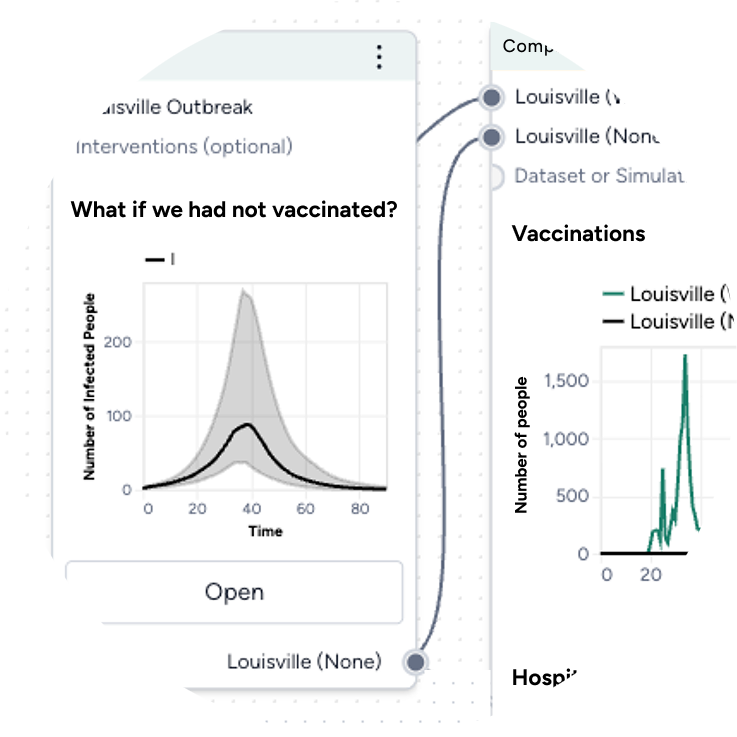
Scientific modeling for infectious diseases faces enduring challenges, including limited model transparency, poor traceability of assumptions and uncertainty, and difficulty adapting legacy models amid rapidly evolving scientific knowledge. Terarium is a novel, open-source modeling platform that integrates human-in-the-loop AI to address these gaps. This study presents Terarium and results from a systematic evaluation in epidemiological modeling, assessing its potential to accelerate modeling workflows while improving rigor and interpretability.

2025
2024
-
In the evolving field of scientific modeling research, computational notebooks have made steps to promote collaboration by providing interactive environments for code execution, visualization, and narrative composition; however they are still limited. To overcome these limitations, we introduce Terarium, a platform that attempts to socialize scientific modeling for a broad audience, including students, researchers, and data scientists.
2021
-
 Best Paper, VAHC Workshop, IEEE VIS 2021
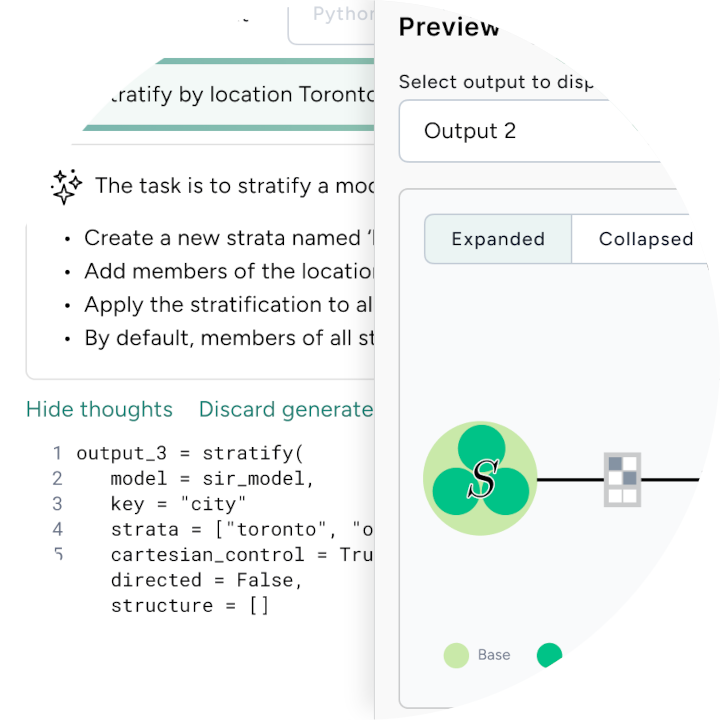
This paper describes an ongoing multi-scale visual analytics approach for exploring and analyzing biomedical knowledge at scale. We utilize global and local views, hierarchical and flow-based graph layouts, multi-faceted search, neighborhood recommendations, and document visualizations to help researchers interactively explore, query, and analyze biological graphs against the backdrop of biomedical knowledge.
-
Biologists grapple with large multi-scale graphs to find relevant subgraphs for answering a range of biological questions. Our approach for scalable graph analysis enables biologists to interactively explore, query, and analyze biological graphs at different scales. Computational biologists see promise in our approach for various use cases such as drug interactions and disease propagation.

